A reinforcement learning environment written from scratch in JAX.
Source on GitHub.
I built foragers world as a way to explore simulated environments in JAX, evolutionary processes and
population control RL. The world is designed to be simple by nature (only one control lever, small environment state) to allow a researcher
to reason with changes made by the agent. The goal of the RL agent is to control the population of foragers
within a given band. Critically, it is important where this band sits, and I found that controlling the population
closer to the extinction threshold was much harder for the agent.
Foragers
Foragers are simple creatures. They breed asexually and randomly walk around their
grid environment. They have a measure of energy which is depleted when they take a step and when
they breed. Breeding splits their energy between them and their offspring and requires a minimum amount
of energy to do.
Agent
The RL agent watches that population and gets one lever - a global
movement cost. Raising the movement cost causes foragers to burn energy
more rapidly and die off. Lowering it allows them to move about and breed more easily.
The goal is to hold the
population inside a target band for as long as
possible, scoring +1 for every step it stays there over a
500–step episode.
Environment
The whole simulation environment is pure functional JAX. I utilised fixed size arrays
and masks to enable the use of VMAP and parallel simulations. Food is randomly placed throughout the
gridworld initially, and regrows stochastically to a per tile cap.
Three regimes
The following three serve as baseline regimes with a fixed movement cost. The first example shows a population collapse where the cost
of movement is too high so the population simply collapses.
The second shows a relatively stable population that oscillates roughly within the required band.
Finally we have a boom-bust population. Movement cost is low so the population expands rapidly, consumes its resources,
then starts dying out. The population is able to recover as the foragers can move around cheapily and consume the ever increasing
food while the population is dying.
These are real trajectories exported from the simulation, Green is food, dark dots
are foragers, and the shaded strip on each chart is the target band.
Collapsecost — · regrowth —
loading…
Movement costs more energy than a tile of food returns.
Everyone starves within a dozen steps, long before the
band is reached. Return —.
Stablecost — · regrowth —
loading…
The best fixed action. The population settles around the
band and drifts across a range of roughly 100, grazing
the map down and letting it regrow.
Return —.
Boom and bustcost — · regrowth —
loading…
Cheap movement in a leaner world. The population
overshoots to twice the band, strips the map, crashes,
and repeats — a range of nearly 200, passing through
the band without ever settling.
Return —.
Baselines
policy
move cost
return
extinct
best fixed action
1.50
298
0%
second best
1.25
247
0%
uniform random
—
38
94%
too cheap
≤ 1.00
1–8
0%
too expensive
≥ 2.00
0
100%
The learned agent
The agent uses PPO, written in JAX in the style of
PureJaxRL.
Its observation is a three-dimensional vector of global aggregates (total
food, population and mean energy) with no spatial features or history.
The action space is discrete: 12 move costs from 0.0 to 2.75.
The band is a parameter of the environment, so I trained one policy for
each of four bands, for 5M environment steps each.
band
range
PPO
best fixed
fixed cost
extinct (PPO / fixed)
wide
80–140
496
298
1.50
0% / 0%
ceiling
120–154
448
203
1.25
0% / 0%
floor
0–30
349
84
1.75
27% / 69%
tight
75–85
270
66
1.50
0% / 0%
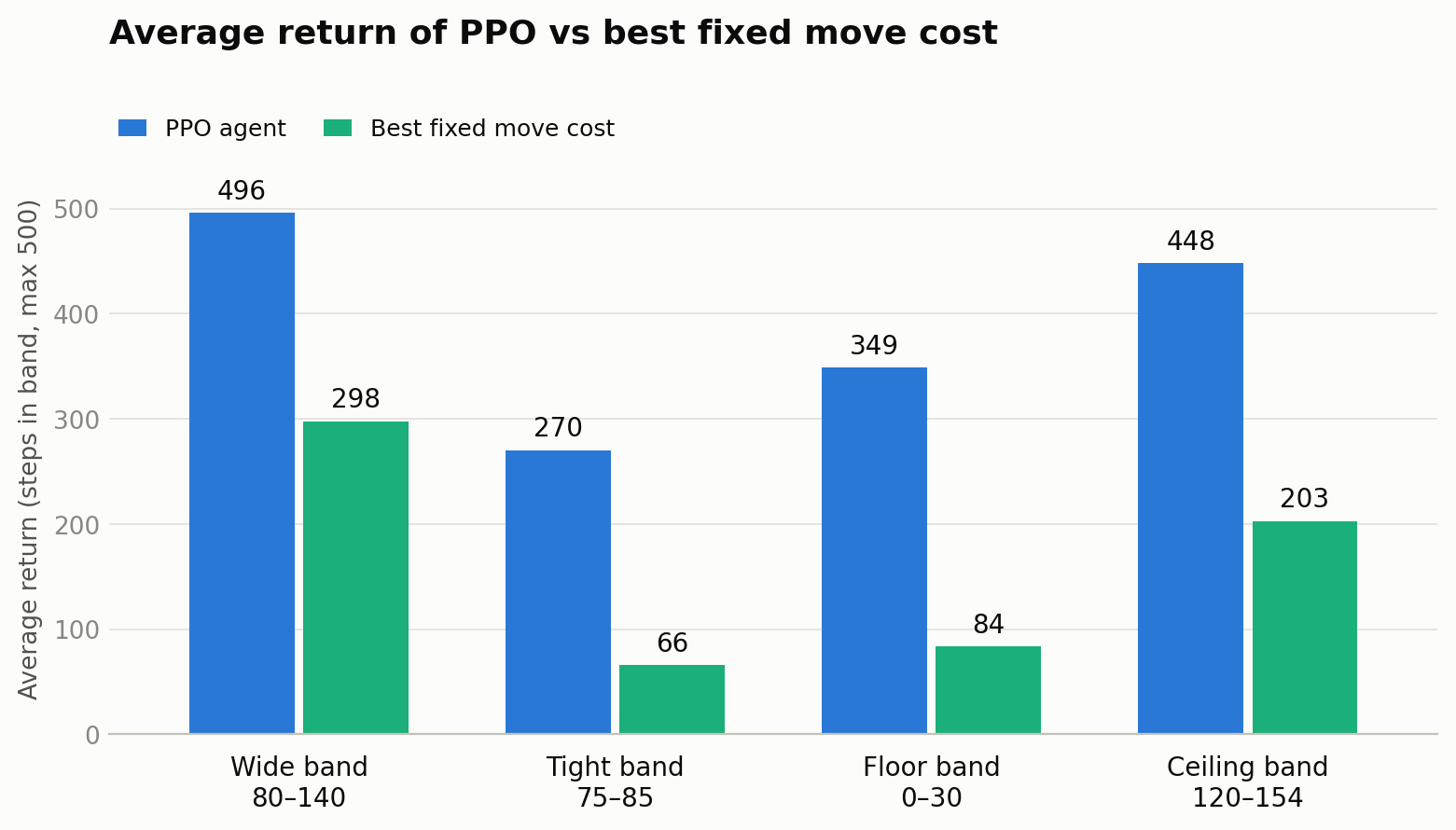
Based on average return over 256 evaluation worlds, PPO outperformed the
best fixed move cost in every target band. In this setup the wide band
is essentially saturated: with a band about 60 foragers wide, the agent
scores almost perfectly on average (496 of 500).
Training
Each band trains for 5M steps, which takes about two minutes on a
M4 Pro Macbook Pro. I used Adam with a learning rate of 2.5e-4 that decays to zero
over the run.
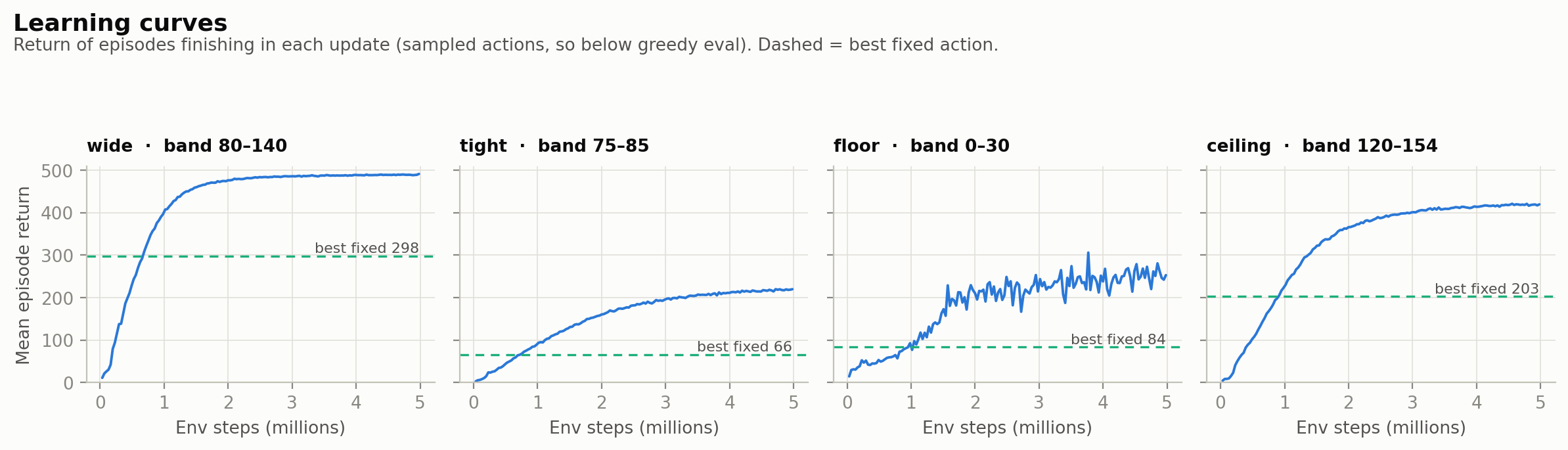
It learns fast. Every band beats the best fixed cost within the first
million steps (about 20 seconds). The wide, ceiling and floor bands
level off by around 3M steps, while the tight band is still climbing
when training stops.
These curves sample from the policy instead of taking its best action,
so they sit a little below the scores above.
What did it learn?
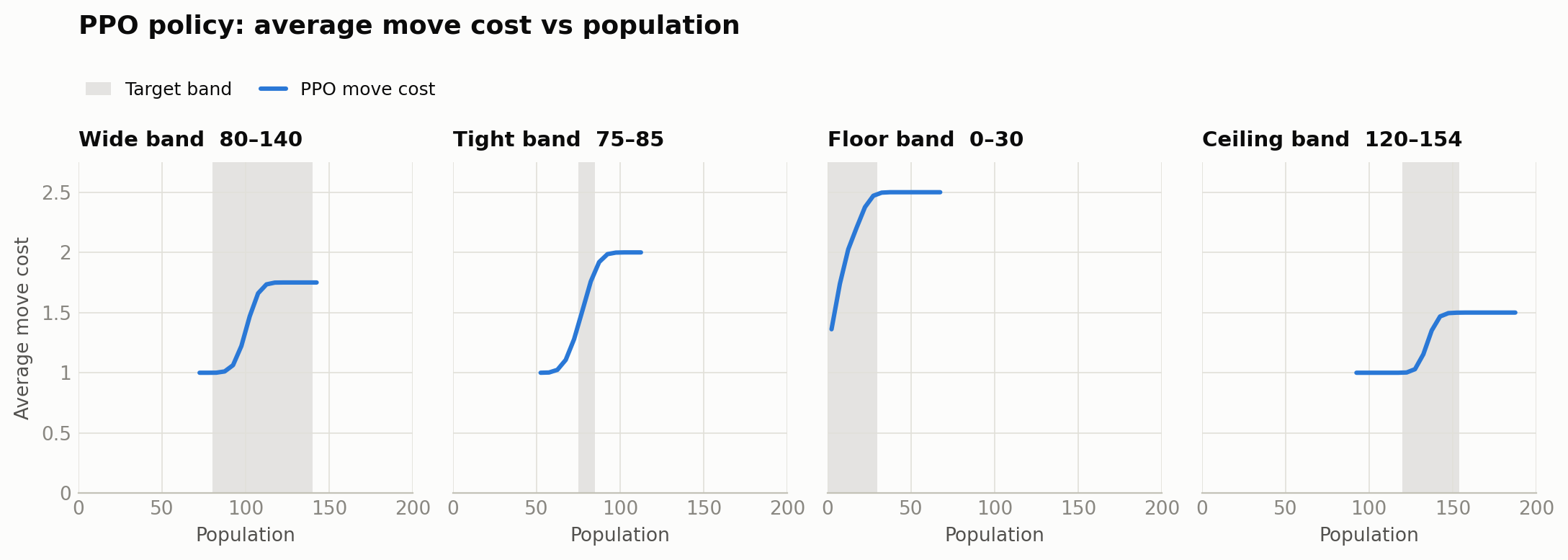
The agent learns a very basic threshold controller. As the policy in
each band shows, it switches from a low cost to a high cost across the
middle of the population band. Where that switch happens depends on the
size and location of the band relative to the total population, food
and grid settings.
It changes cost on most steps, around 290–350 times per 500-step
episode, so it behaves like a thermostat rather than a smooth
controller.
Wideband 80–140 · cost —
loading…
Return —.
Ceilingband 120–154 · cost —
loading…
Return —.
Floorband 0–30 · cost —
loading…
Return —.
Tightband 75–85 · cost —
loading…
Return —.
Caveats and next steps
Each band has one training seed and one untuned set of hyperparameters
(the PureJaxRL defaults), so nothing here says how reliably PPO finds
these controllers. The tight and floor bands are the weakest.
The floor band's 27% extinction rate mostly comes from the start of
each episode, when the population grows quickly and the agent then culls
it too hard. Being able to observe the rate of change of the population
may let the agent do better here, and that is what I will look at next.
Further experimentation into the floor control band, where the agent has
to balance the risk of extinction against holding the population in
band, is worth investigating.